
Our Neurological Control System
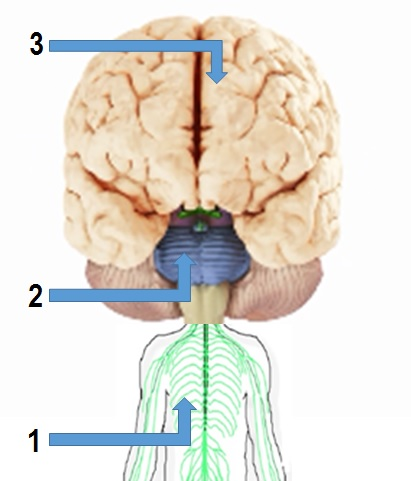
Our survival and behaviour is controlled by neurons in our body. Neurons are a type of cells that can transmit and process information. Human beings are blessed with over a 100 billion neurons. Together they organize themselves to control all facets of our life. This organization is shown graphically in the figure above. Three neural structures are noteworthy:
- Nervous System,
- Limbic System, and
- The Neocortex
The limbic system and the neocortex are two functional parts of the brain located in our head while the nervous system is spread all over the body. The nervous system collects information of two types: internal state information from every part of the body and external information from perceptible events around us. It then conveys the information to the brain which immediately reacts or responds after due processing with state control or behaviour information to the respective locales in the body or the muscles for executing the intended response.
The nervous pathway to the brain is through the spine and the brain starts from the top end of it. Thus, the nerves pass through the limbic system of the brain before it accesses the cortical structure making the information they carry available first to the limbic system and then to the neocortex. The limbic system is the fast acting part of the brain while the neocortex is slow acting. Nature is wise in devising this arrangement.
The fast acting limbic system is meant to deal with the issues of physical and emotional survival. Physical survival issues include bodily functions such as breathing, heartbeat, digestive system, metabolic functions, hormonal and lymphatic systems, etc. which must work "automatically" 24/7. They must be run in a systematic manner without delay like a clockwork so that we biologically survive well.
Our limbic system is in charge of overseeing our survival. It continually monitors physical state information from every part of our body. It then responds to all such information in an unconscious and autonomous manner maintaining biological homeostasis. Keeping us in survival mode physically is the most vital function of the brain where timely control can be a matter of life and death; homoeostasis must be maintained in an automatic manner without any processing delay whatsoever. Such automatic control is exercised with reflex responses generated in the nervous system itself culminating in the brain stem, an anatomical component of the limbic system.
The work of maintaining homeostasis is a daunting job. A large number of critical events need to be monitored and controlled "automatically" without any awareness on our part whatsoever. This control is similar to a wall thermostat controlling the home heating furnace. We set the temperature to be maintained and the thermostat maintains it by continually monitoring the temperature to start the furnace when the temperature is too low and shut it when the temperature is too high. In our homes, there is only one thing to be controlled to maintain a comfortable inside temperature, but in our bodies there are many things to be controlled. Our limbic brain thus is like many automatic control devices such as a thermostat.
Who decides what temperature to maintain in our homes? We decide. Having decided, we set it on the thermostat. Who sets the many set points of thermostat like control devices which our limbic brain act as. The answer to this question is that the set points are decided by our genetic structures and their expression, our genetics and epigenetics. Once set at birth, they are being continually reset as the environmental influences alter our gene expression; our epigenetics is always changing. These set points determine our disposition to run our autonomous physical functions in our specific ways.
What is the physiology of our disposition to run our autonomic functions? The physiology of this disposition is defined by three related states:
1. The structure of neural connections of our brain: this circuitry can encourage or hinder the neocortex from being involved in running human life,
2. Our hormonal mix as defined by cortisol/DHEAS ratio: The higher this ratio, the more the activity of the limbic system favoured by the neural circuitry over that of the neocortex. This has been called the emotional hijacking of the thinking brain,
3. The relative activities of the sympathetic and the parasympathetic divisions of the autonomic nervous system: the higher the activity of the limbic system, the higher the sympathetic dominance. Higher the sympathetic dominance, the faster we run all our autonomic systems with the exception of digestion which slows down.
The action of our limbic system to run our autonomous life support systems is the physical correlate of the unconscious mind. Remember, Freud's structural model of the mind informs us that the largest structure of our mind is the unconscious mind. The second largest is the subconscious with the conscious as the smallest being the smallest in size.
Just like the homoeostatic set points at birth are determined by our genetics and epigenetics and later continually changed as our epigenetics changes with life experience, our mental instincts are also determined by our genetics and epigenetics.
Mind and body are not two; they in fact are one. Two words being used for them should not be interpreted as duality of their existence. What is autonomic functioning of our physiology to the body is what the subconscious working our emotional life is to the mind. The mechanism that defines our physiological disposition also defines our psychological disposition.
We start existing in this world as a single cell organism, the most vulnerable life form that is imaginable. As such, physical survival is the most important issue on our mind. We are thus built to save ourselves from all threats to life. No ifs and buts are tolerated when faced with danger to physical survival. Our brains thus are wired to immediately save us physical extinction. Fear of death then is the most urgent survival related emotion. Then, there is fear of physical pain, fear of something unpleasant happening; we hate unpleasantness. Such fears are treated with an urgency not much less than the fear of death.
How about the fear of losing things that are pleasant? We like money; how about the fear of losing money or losing our health? We want to deal with such fears as well with the urgency they deserve.
Other emotions include expectation of pleasantness. We all have habits in which we love to indulge. How about such indulgences, can we leave wait to indulge? Perhaps no if we really like something, and perhaps yes if the liking is not too strong. We deal with pleasant indulgences with the urgency we think they deserve.
When our brain receives information from the nervous system about something fearful, pleasant or unpleasant happening outside in the external world, it makes a judgement about its urgency. When we deem the incoming information as lacking urgency, we can timewise afford to refer it to our neocortex for processing and the generation of a considered response. The judgement we make depends upon our current disposition defined by the neural circuitry, hormonal ratio, or sympathetic dominance.
When we feel the incoming information as urgent, we react to it subconsciously without wasting time in processing it. Immediate control of our emotions lie in two neural structures called amygdalae located in the limbic system of the brain. The amygdalae generate quick and mindless response to our fast track emotions with increased activity of the sympathetic over the parasympathetic division of the autonomic nervous system.
Our single cell beginning makes us fearful of our lives. This makes us ready to “fight or flight”. Our bodies always keep ready for it. Thus sympathetic dominance is our natural state. Sympathetic dominance means we are always activity oriented ready to go. We are born that way and we live that way. This is the underlying cause of attention deficit in which we spend our lives.
Is there a way out of our innate activity readiness and attention deficit? If so, what? Must we live in the natural disposition of our birth?
We can train our brain to be attentive with the use of our breath. Ordinarily our breath is autonomic. As an autonomic process, it has its control in the limbic brain. Being autonomic, this control is unconscious. Then there is a subconscious control. This control becomes obvious when realize how our subconscious emotions change the way we breathe. Then, there is a third control which lies in the neocortex, the tool of exercising our consciousness through thought, awareness and consideration. We need to learn to use this conscious level of control to run which ordinarily is an unconscious body function.
Can we do the same with other autonomic functions of the body? No, because there is no other autonomic physical process running automatically that lends itself to dual or multiple controls. Lacking any conscious or subconscious control, we cannot consciously exercise any control over them, whatsoever. They must depend upon autonomic regulation as per our current disposition.
Because of our sympathetic dominance, breathing as well as other autonomic physiologic functions run faster that their optimal speeds. This is the nature of sympathetic activity. We can consciously take charge of our breathing and run it deliberately at a slower than its natural rate. This slows down the activity of the sympathetic division of the autonomic nervous system and increases that of the parasympathetic reducing sympathetic dominance. This is the secret to changing our natural disposition.
If we practice exercising conscious control of our breathing process reducing our rate of breathing regularly, over a period of time our natural disposition changes more from unconscious and subconscious to conscious, from mindless activity orientation to activity when considered necessary, from attention deficit to attentiveness, from reactivity to thoughtfulness, from survival orientation to fullness of life and love.
Yes, nature that creates our limiting disposition also gives us a way out of it. But, we have to make a concerted effort to gain our freedom from it. This effort also frees us from the slavery to the so called subconscious emotions. With this awareness, we can strip them of their deemed urgency and lead a meaningful as well has healthy life.
As we gain this freedom, we change our identity. Our natural life gives us a body identity. Our emotional life extends this body identity to that of sense gratification. With this extended identity, we live not only for the body but for all those that are connected with our body through the senses: our family, our neighbours, our village, our language, our religion and our community. Our conscious life of freedom from our survival and survival related emotions with continual use of our neocortex, our identity spreads as far as the reach of our awareness. We then are introduced to an "I" beyond the physicality of the body, nerves, limbic system and neocortex that has the final control. Isn’t it that “I” which chooses to use the conscious breathing control located in the neocortex to override its unconscious and subconscious controls in the limbic structures of the brain which gets us our freedom from our natural dispositions and our survival emotions?
Thus simple practice of deep breathing can make us realize I am more than my body, my nervous system and my brain:
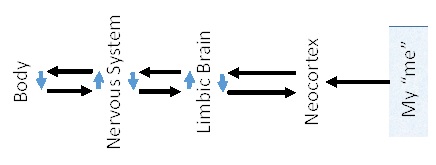
My body sends information to my nervous system which my send a reflex response back to the body or forward it to the limbic brain. The limbic brain may react to by itself or refer it to neocortex which processes it consciously and respond to it. The limbic brain if it likes the response sends it to the nervous system or negotiates it back with the neocortex. Similarly the nervous system can send the response to the body to be executed or it may choose to negotiate it backwards. There is freedom at every level from my “Me” and the body. My “Me” or “I” is the final authority, the chief operating office who can only act when the operating staff cooperate and recognize it as such.